Travelling is fun. Millions of people enjoy it as pastime. Then you have kids and suddenly, travelling becomes logistics and catering, not to mention hydration, sanitation, lodging and last but not least: entertaining.
The 80 kilometres that changed it all
While ago, we decided to visit Bratislava for a day. By car, from Vienna, it’s mere 80 adult kilometres or one adult hour.
Now, that might not sound like a long journey, but when you got a 5 and a 2 year-old strapped to their seats, one hour becomes 60 minutes and every minute 60 seconds.
You know, because you count. And if you forget, not to worry, the back seat will remind you.
Alternative distractions
There’s limit to how much you can entertain a kid by giving them a cookie and it’s not a sustainable solution: You’re bored, have some crappy calories.
Neither does distracting cut it: “Hey, have a look at that nice view…umm… a logistics hub by the motorway…”
Suggesting rest: “Why don’t you two have a nap so you’re full of energy once we arrive?” Nope? Daddy with sleep deprivation surely wouldn’t mind dozing off on the wheel.
Why don’t you two have a nap so you’re full of energy once we arrive? Nope?
Every parent loves their kids to be active and engaging individuals, but sometimes in a car or on a plane, passive ones would do just fine.
Drugging kids with sedatives is not generally considered as viable solution. It’s a bit of a faux pas morally and in the eyes of the law. What is there left then?
In-car entertainment
When I was browsing the internet for an in-car entertainment system, I had few red lines:
- It ought to be securely attached to the headrests
- It should be trouble free
- Easy to use even for kids
Headrest mounts
Secure attachment rules out all velcro straps as they’d be fiddly and just a plain eyesore. Because we’re driving a Volvo, the headrests are not adjustable and have no exposed pins, so the regular headrest mounts would not fit.
The Swedish problem also has a Swedish solution in the form of a very overlooked and undervalued company called Brodit AB. They make brilliant device mounts that are car- and device-specific.
I bought two car-specific headrest mounts to begin with. They cost me some 49 eur each from Amazon.de, so around hundred euros altogether.
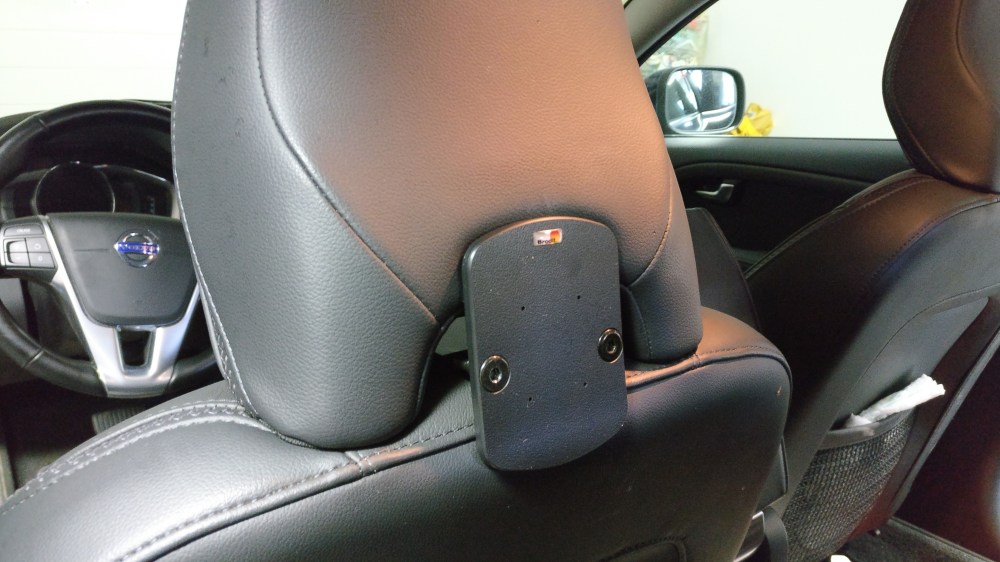
These I got weeks before I decided what devices I’d buy for the kids. But they were a solid base, literally to build on.
DVD player or a tablet?
Originally, I was thinking of getting two individual DVD players to the back. Two, because our kids would not agree on watching the same content: Peppa Pig versus JustinTime Go or whatever. But the idea of acquiring and fiddling with the discs kind of put me off.
Many DVD players seemed to have an optional remote control which I’m not sure is a pro or a con. The back-benchers would lose or drop them and start moaning “I dropped my remote control” when cruising on ze Autobahn 5km from the nearest exit. So you’d have to duct-tape the remotes to their wrists anyway. Tablets with touch screens do not have that problem.
It would have also been seriously outdated an approach. Fully aware that there might be known knowns or known unknowns I still opted for tablets. On Amazon there are some hybrids; android tablets with a DVD player, but they looked a bit flimsy.
So tablet it is then.
iPad, Android or Windows?
Having looked at serveral tablets in showrooms I was none the wiser. Android maybe, but what manufacturer, model etc? And the prices were quite steep.
Many recommended me iPads, but at some 500 euros a pop, getting two would have been too much. And frankly, the idea of a Windows tablet didn’t appeal to me at all.
Amazon Kindle Fire HD 10
I took a calculated risk, a known unknown to go for Amazon Kindle Fire tablets. They come in 7″, 8″ and 10″ sizes and honestly, the 10 inch size was a good choice. I was afraid the 10″ screen being too big, but one gets used to it quickly. Also, it being an in-car tablet, bigger is always better.
Having read many reviews, HD 10 seemed to be the snappiest of the Amazon tablets regarding processor and graphics and general usability.
The prices start around 100 eur for the 32 GB internal storage, but I opted for the 64 GB versions as I read that some apps might allow downloading offline content only on the internal storage, not the micro SD card up to 256 GB (not included). I also paid a little extra to get version without ads on the lock screen as these were tablets the kids would use.
Amazon’s Appstore
One risk, or rather a limitation with the affordable Amazon tablets is the fact that it runs on Amazon’s own operating system.
Well hidden, but the Fire tablets still run on android and it is possible to “side load” apps, by-passing the Amazon Appstore. I gave it a go and followed instructions but have yet to master the art of side-loading.
Brodit universal tablet holder
Now that I had the tablets, I somehow needed to mount them onto the headrests. Brodit doesn’t make device-specific tablet holder for Amazon HD 10 so I had to buy universal ones that would be of the right size.
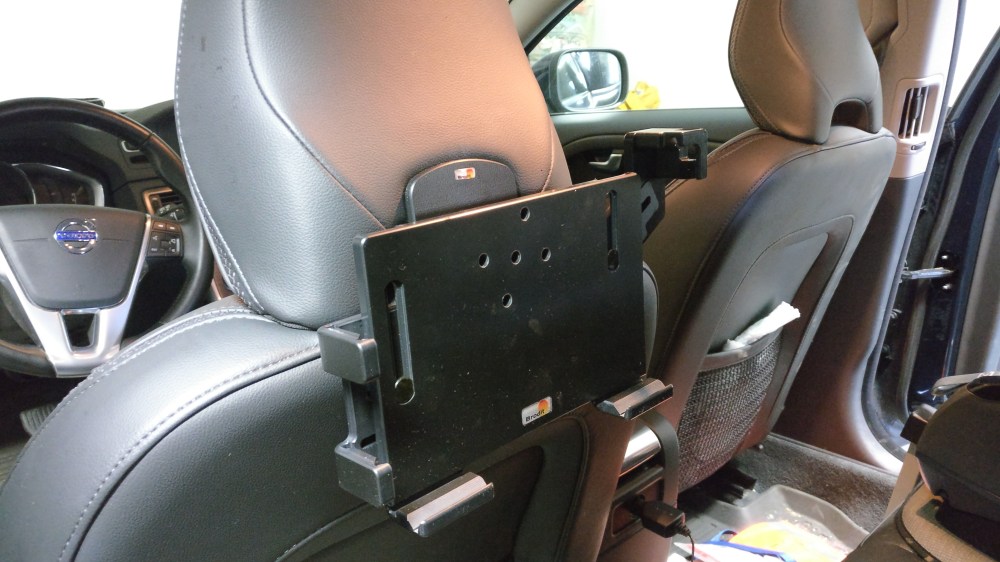
The instructions on Brodit website are somewhat cryptic as they say that the upper right corner is “the resilient right arm”, but the Swedish version is fjädrande, which translates better as springy.
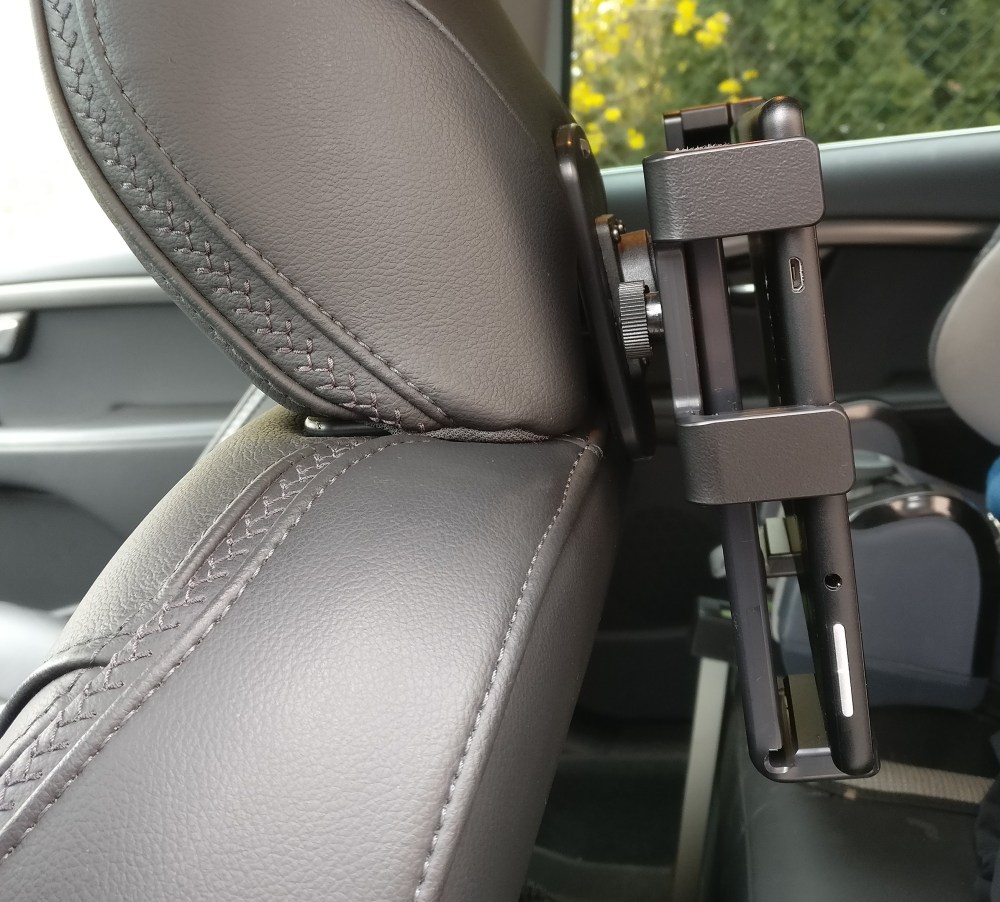
Anyway, the tablet is a snug fit with the universal holder, although some of the ports will be inaccessible. I chose the power button to be behind the left -side arm, as the other option would have been to cover the 35mm socket for the earphones or the micro-usb port to power up the tablet – not that it needed any juice during a 4 hour drive.
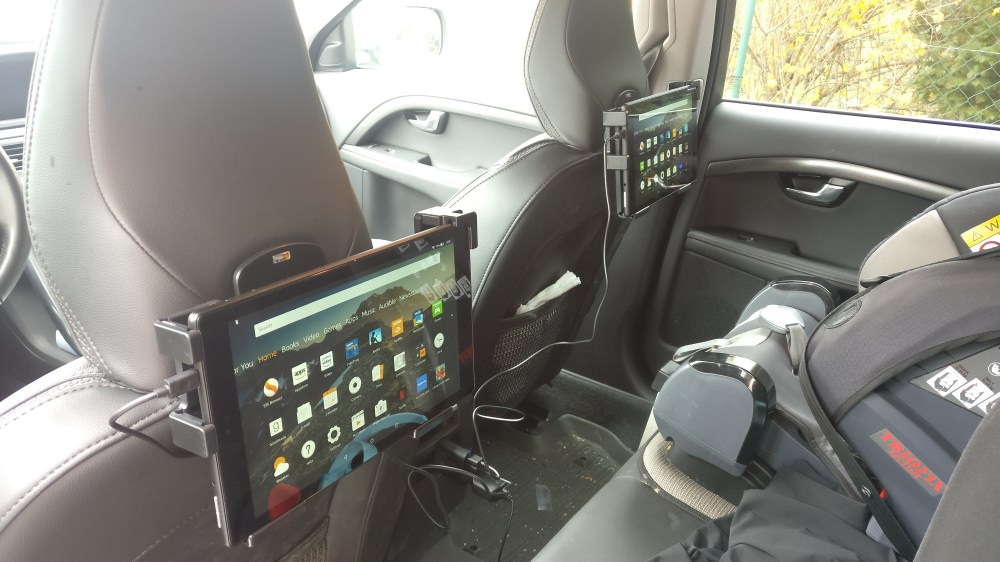
Amazon promises that the battery will last for 10 hours and on a normal leg up to 5 hours, watching offline content is manageable. I got the full set, with a USB-splitter for the back, but so far I haven’t needed it.
Headphones, definitely
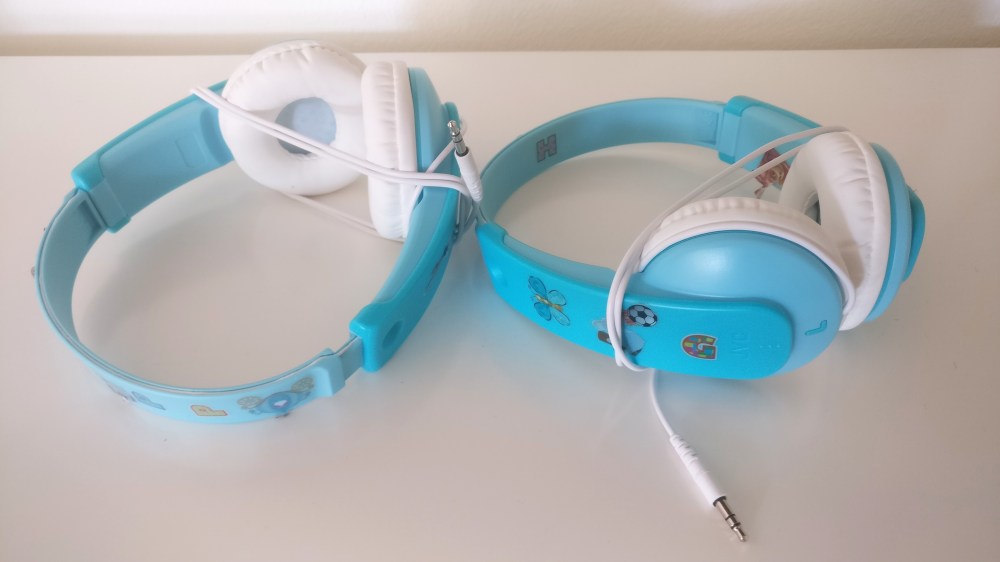
When considering any portable device for a kid, the first thing to remember is to get them headphones. If you’ve forked out money for the tablets and possibly content, the 20 odd euros for kids’ headphones is a no-brainer. Do buy them kid-specific ones; they are a better fit, usually more durable and often have a volume limiter.
It’s also polite to use headphones for kids hand-held devices in public places. Something, that adults too could consider when on a train or a plane.
I could have gone for wireless Bluetooth versions, but I didn’t want to worry about battery life or the problem of connectivity.
These on-ear versions seem to work fine, but ideally over-ear versions covering the ears would be even better.
One could also go all the way and get wireless, over-the ear, noise-cancelling quality headphones, but I didn’t come across any for kids and the price goes up substantially.
Silence is Golden
I had tested the tablets with the kids on a school run, but the crucial test was our 400km journey to Bled, Slovenia.
The new-found silence in the car is priceless. You can actually have a meaningful, un-interrupted discussion with the front passenger.
Zen.
 hannu.blog